There are rivers. And then there are Chilean rivers.
If you’ve paddled California’s South Fork American River and felt that pull — that specific feeling of wanting more water, bigger mountains, longer days on the river — Chile is where that pull leads. It’s not hyperbole to say that Chilean Patagonia and the Araucanía region contain some of the most extraordinary whitewater on the planet. We’ve been running expeditions here for years and the rivers still stop us in our tracks.
But why Chile specifically? And what does it actually feel like to be there? Here’s an honest answer to both questions — told through a day on expedition.
Why Chile
Chile has a convergence of factors that’s genuinely rare in the world of whitewater. The Andes feed rivers that run cold, clear, and powerful through landscapes that feel prehistoric — ancient araucaria forests, active volcanoes, glacial lakes the color of turquoise glass. The rivers range from accessible Class II floats to world-class Class V rapids, often within the same valley. You can spend a morning on technical whitewater and an afternoon soaking in a natural hot spring with a volcano on the horizon.
The two regions we paddle — La Araucanía in the Chilean Lakes District and Patagonia further south — each offer something distinct.
La Araucanía, centered around Pucón, is adventure headquarters. The rivers here — the Liacura, Trancura, Palguin, Maichin, Puesco, Fuy, and San Pedro — run through the Huilo Huilo Biological Reserve and surrounding wilderness. The variety is extraordinary — pool-drop creeks, big volume rivers, and everything in between. Pucón itself sits at the base of the active Villarrica volcano, which has a way of reminding you that you’re somewhere genuinely elemental.
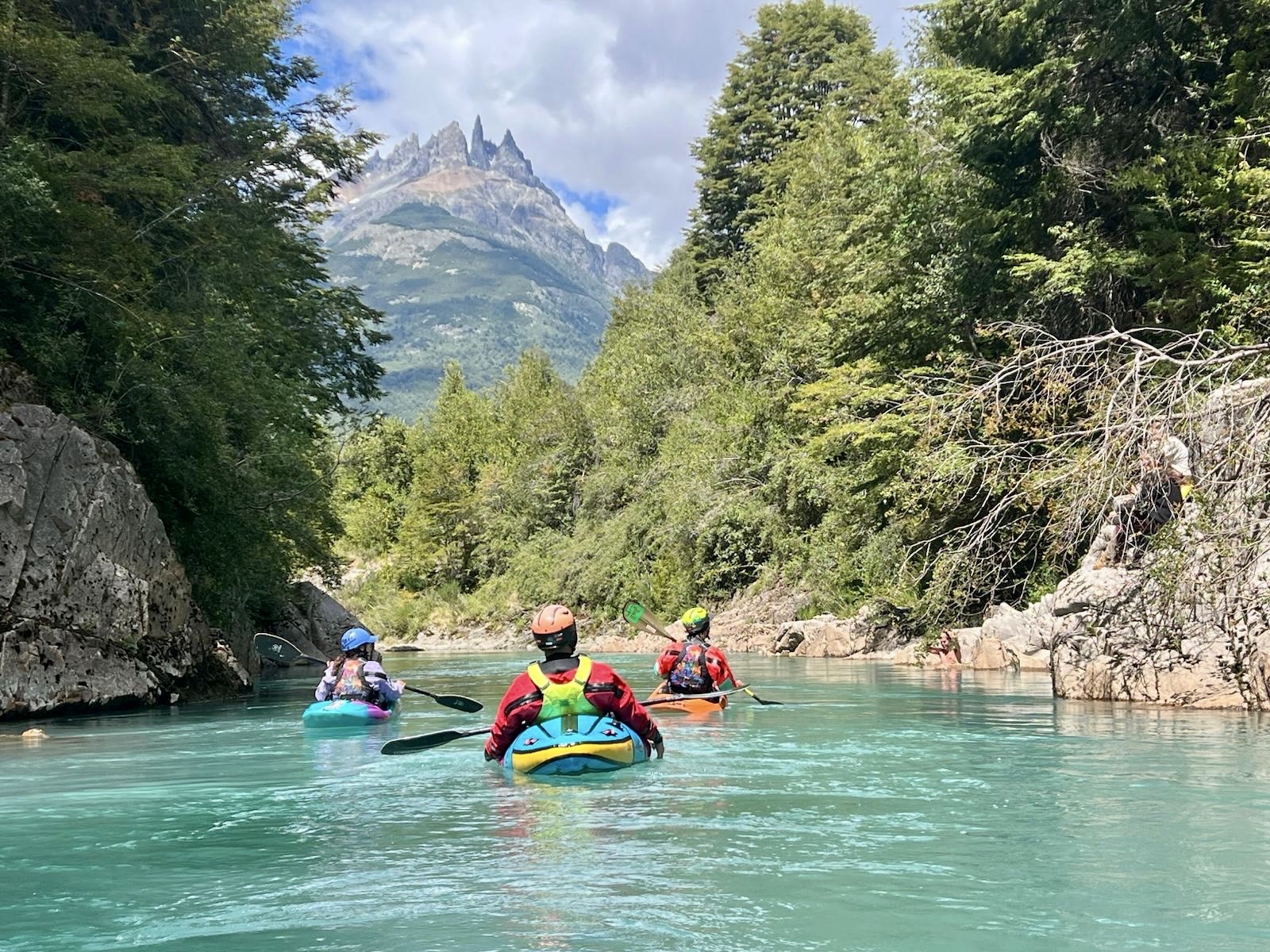
Patagonia, centered around the Futaleufú river, is a different animal entirely. The Futa is one of those rivers that paddlers talk about in reverent terms — a bucket list river that delivers everything the legend promises. Glacier-fed, turquoise, powerful, and set in a valley so beautiful it feels almost theatrical. Its tributaries — the Espolón and Azul — offer equally stunning paddling at a range of skill levels.
Together the two regions make for an expedition that covers extraordinary ground — both on the water and off it.
A day in the life — La Araucanía
The alarm doesn’t feel like an alarm here. You wake up to the sound of the river and the smell of breakfast being prepared by our local Chilean chef — fresh bread, eggs, fruit, strong coffee. The morning light comes in sideways through the araucaria trees.
Gear is rigged by 10am. The group gathers at the put-in — kayakers checking their outfitting, packrafters inflating their boats, everyone going through the familiar pre-paddle ritual that feels the same whether you’re on the South Fork or the Fuy. There’s a morning briefing — today’s river, the key rapids, the plan — and then boats are on the water.
The Fuy runs through the Huilo Huilo Reserve — a private nature reserve that protects one of the last old-growth valdivian temperate rainforests in the world. Paddling it feels like paddling through something that shouldn’t still exist. The forest comes to the water’s edge. The rapids are clean and technical. The pools between them are so clear you can see the riverbed from your boat.
Lunch happens on a gravel bar in the sun — sandwiches, fresh fruit, the particular satisfaction of food eaten on a river bank. The afternoon session covers the lower canyon, where the river kicks up and the lines get more interesting. By the time you’re off the water the light is long and golden and nobody wants to stop talking about the day.
Dinner is back at the lodge — a proper Chilean meal prepared by people who know this food and this land. Wine from the region. A fire. The kind of conversation that happens when a small group of people have spent a day doing something genuinely challenging together.
A day in the life — Patagonia
The Futaleufú announces itself before you see it. The color hits you first — that impossible glacier blue that looks artificial until you’re standing in it. Then the scale. Then the sound.
A day on the Futa is organized around the river’s character — which is serious, demanding, and generous in equal measure. Morning sessions might focus on the Espolón, one of the Futa’s tributaries, where the rapids are technical and the consequences are manageable. Afternoons might move to the main stem — scouting lines on the bigger rapids, picking apart the hydraulics, running what you’re ready for and walking what you’re not.
The Futa has a way of focusing your attention completely. When you’re on the water here there is nothing else — just the river, your boat, and the next move. That kind of presence is rare and most people don’t realize how much they needed it until they’re there.
Off the water Patagonia delivers in every other direction too. The valley is farmed and inhabited in the Chilean way — horses in fields, wooden houses, smoke from chimneys. The people who live here have been connected to this river for generations and that relationship comes through in how they talk about it. Evenings are long in January and February — the Southern Hemisphere summer means daylight until 10pm — and there’s always somewhere to be: a local farm, a riverside asado, a walk to a waterfall that takes your breath away.
Who these trips are for
One of the things we’re most proud of about CWC Chile expeditions is the range of paddlers who come. These aren’t expert-only trips. Class II paddlers and up are welcome — we structure each day so every paddler is on appropriate water for their skill level while the group stays together as a community. Beginners experience rivers they never thought they’d paddle. Advanced paddlers push into lines that challenge them genuinely. Everyone sits around the same fire at the end of the day.
If you’ve paddled with us on the South Fork and wondered what’s next — this is what’s next.
Ready to go?
CWC Chile expeditions are 8-day all-inclusive trips covering accommodation, meals, ground transportation, professional guiding, and all paddling gear. We partner with local Chilean outfitters, chefs, and guides — people who know this land the way we know the South Fork.
Spots are limited. These trips fill months before departure.
Learn more about Chile trips → Chile with Cali Collective
Contact us to reserve your spot → info@cwwcollective.com