
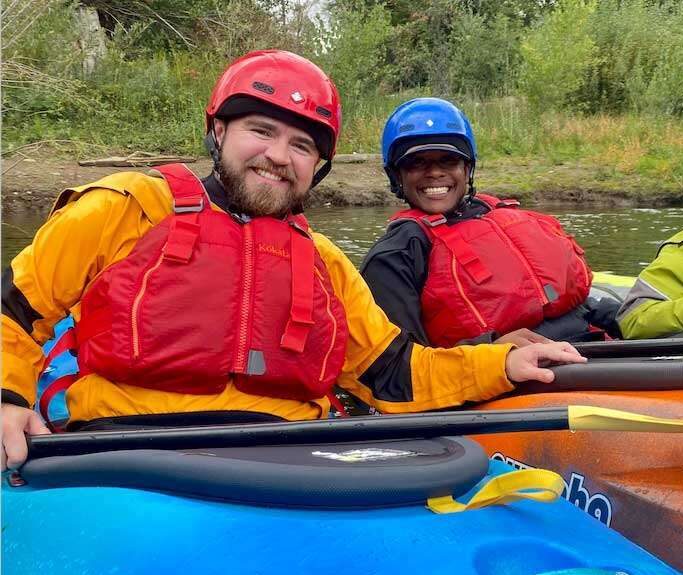
For a fun day out on the river
What you wear on the river matters more than most people expect. Show up in the wrong gear and you’ll spend the day cold, uncomfortable, and distracted — which is not the headspace you want when you’re learning to read whitewater. Show up dialed and you can focus entirely on paddling.
Here’s the complete guide to what to wear whitewater kayaking on the South Fork American or your favorite river — from the essential gear to the layers underneath, with real recommendations from the instructors who paddle this river every day.
Watch the video first
Before we dive in, check out this quick overview from CWC founder Melissa DeMarie covering the essential pieces of gear for a day on the river:
Now let’s go deeper on each piece.
The essential gear
Kayak
The right kayak depends on your skill level and what you’re working on. At CWC we run Pyranha boats — a brand we trust for their performance, durability, and how well they’re designed for instructional paddling. Beginners typically start in a stable, higher-volume boat that’s forgiving and confidence-inspiring. As you progress into Class III and beyond, a lower-volume creek boat gives you more precision and control. All gear is provided for our clinics — but if you’re shopping for your own boat, we’re happy to point you in the right direction.
PFD (Personal Flotation Device)
Your PFD is non-negotiable — it goes on before you get near the water and comes off after you’re away from it. A whitewater-specific PFD is cut differently from a flatwater or recreational vest — it’s shorter in the torso to allow full range of motion for paddling and designed to keep you upright in moving water. We trust Kokatat for PFDs. Their fit, safety ratings, and durability are consistently excellent and they’re made in the USA. Make sure yours fits snugly — if you can pull it up over your ears it’s too loose.
Helmet
On whitewater you will flip. That’s not a warning — it’s just physics. A properly fitted whitewater helmet protects your head from rocks, riverbanks, and other boats. Look for a helmet specifically rated for whitewater rather than repurposing a bike or ski helmet. Fit matters — it should sit level on your head, covering your forehead, and not shift when you shake your head side to side. All helmets are provided for CWC clinics.
Paddle
Your paddle is your connection to the water — it’s worth getting right. Werner Paddles are our recommendation across the board. They make paddles for every level and discipline, and the difference between a cheap heavy paddle and a well-designed Werner is immediately noticeable in how much energy you spend on a full day of paddling. For beginners a mid-range fiberglass blade is a great starting point. As you progress into higher performance paddling a carbon blade pays dividends. Again — paddles are provided for all clinics so you can try before you commit.
Sprayskirt
The sprayskirt seals the cockpit of your kayak and keeps water out when you’re running rapids or rolling. For whitewater you want a neoprene skirt rather than a nylon one — neoprene holds up to the pressure of whitewater and won’t implode when you’re in a hole. We use and recommend Immersion Research skirts. Their fit across a wide range of cockpit sizes and their durability on high-use gear makes them a staple in our fleet. Make sure you practice wet exits with your skirt on before you run your first rapid — the grab loop should always be accessible.
Footwear
Feet are an afterthought until they’re not. On the South Fork you’ll be getting in and out of your boat on rocky riverbanks, wading through shallows, and potentially swimming. You need shoes with a back strap — nothing that can come off your foot in moving water. Old sneakers work fine. Neoprene booties are ideal in spring when water temperatures are colder. Flip flops and Crocs are a hard no.
Layering for the River
This is where most beginners underestimate the river — and where spring vs summer makes a significant difference.
Spring paddling (April–May)
Spring flows on the river are fed by snowmelt — the water is cold even when the air is warm. A wetsuit is strongly recommended in April and May, and a drysuit is ideal if you have access to one. Kokatat and Immersion Research both make exceptional drysuits and drytops designed specifically for paddling — their Gore-Tex construction keeps you genuinely dry rather than just damp-resistant. Underneath your drysuit or drytop wear a synthetic or wool base layer. Avoid cotton entirely — it holds moisture against your skin and will make you cold fast.
Summer paddling (June–September)
Summer on the river is warmer and some rivers with dam-regulated flows (like the South Fork American) mean more predictable conditions. A wetsuit is still a good idea in June but by July most paddlers are comfortable in board shorts and a synthetic top. You will get wet — plan for it rather than trying to avoid it. A quick-dry synthetic top, board shorts or wetsuit bottoms, and water shoes cover most summer days comfortably.
What to leave at home
- Cotton anything — jeans, t-shirts, hoodies. Cotton holds water and makes you cold
- Open-toed shoes or anything without a back strap
- Jewelry that can catch on gear
- A phone without a waterproof case or dry bag
What to bring that isn’t gear
- Sunscreen — reapplied, because you will get wet
- Water and snacks — paddling is more physical than it looks
- A dry bag for anything you want to keep dry
- A change of clothes and a towel for after
- Sunglasses with a retention strap
One more thing
The single most common thing we see on the first day of a clinic is people showing up underdressed for the water temperature and overdressed for the air temperature. The river sets the dress code, not the weather app. When in doubt, add a layer — you can always take it off.
Ready to get on the water? Browse our South Fork clinics and we’ll take care of the rest.
Browse South Fork Clinics → Click HERE!
Check our FAQ for more gear questions → FAQ